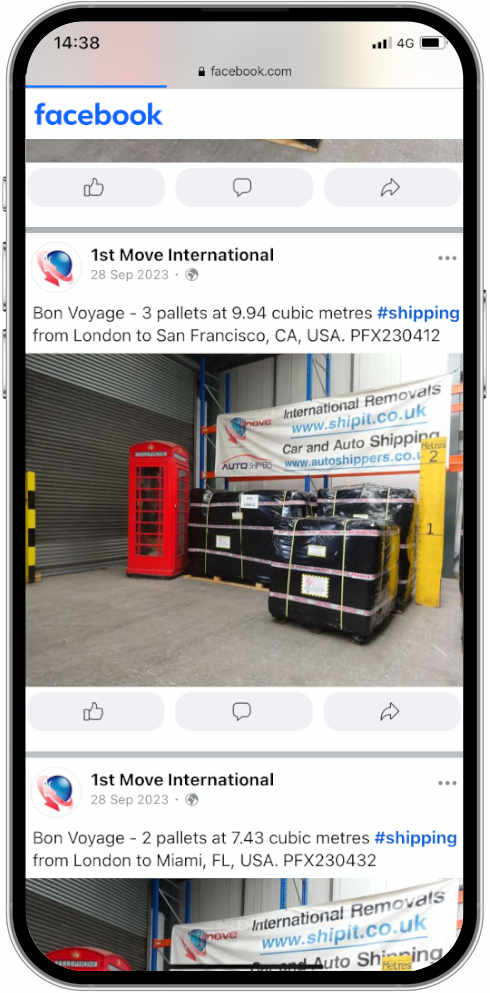

2 pallets · 7.364 cbm · UK to Madame Estate, St Maarten · PFX/102762
View on Facebook →
Planning a move from the UK to the Caribbean? We've shipped to Caribbean destinations for over 28 years, with regular sailings to all Caribbean countries, including the Bahamas, Barbados, Jamaica, Trinidad and Tobago and many more. Whether moving just a few boxes or the full contents of your home, our team handles packing, removals, customs clearance and door-to-door delivery.
Get a tailored free quote from 1st Move International and begin your new adventure today.
We provide guaranteed weekly shipping to the Caribbean, with UK-wide collection, packing and fast weekly shipping. Fill out our quick and easy form to receive a tailored quote for your required services.
The average cost of international removals from the UK to the Caribbean ranges from £600 to £3,000 for a small move via a shared container and from £3,000 to £6,000 or more for a larger full-house move in a full 20ft or 40ft container. Your total moving costs will depend on the services needed, the size of the move, and the final destination.
See our table below to find out our moving costs to the Caribbean
| Move Size | Service | Cost |
|---|---|---|
| Small Move / Boxes | Groupage | £625 - £725 |
| Small Flat | Shared Container | £1,028 - £1,912 |
| 1-Bed House | Shared Container | £2,244 - £2,790 |
| 3-Bed House | 20ft Container | £3,825 - £4,147 |
| 4+ Bed House | 40ft Container | From £6,333 |
Important information about these moving costs
Use the above costs as a guideline so you can get a rough idea of what to expect. Costs shown don’t include collection, delivery, packing or loading costs. For an accurate quote, complete our easy form, and we'll get back to you with a detailed and accurate cost for your move.
Discover the best move type for you.
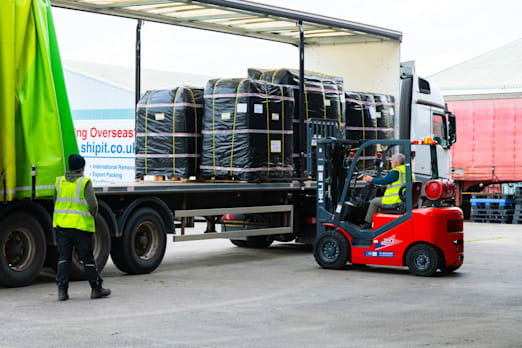
Shared container shipping is ideal for smaller moves, typically suited for shipping the contents of a 2-3 bedroom home. You’ll share container space with other customers, so you only pay for the space you use, making it a very cost-effective way to move to the Caribbean. Our packing not only offers unbeatable protection, but allows us to ship alongside commercial goods on regular, weekly sailings.

If you’re moving a large number of items, such as the contents of a 3-4+ bedroom home, then our full container shipping service will be best suited. You’ll have sole use of a 20ft or 40ft shipping container which can be loaded at your home or back in our warehouse. Our professional packers can collect your belongings and pack them safely and securely.

Takes 60 seconds. Free, and no obligation.
We provide door-to-door international removals across the Caribbean, with regular sailings to all major destinations.
 Removals to Antigua and Barbuda
Shipments to Antigua and Barbuda arrive at the Port of St. John's, the main commercial gateway for both islands. Weekly sailings from the UK take around 35 days, with cargo transhipped via Miami onto a smaller feeder vessel for the final leg into the Caribbean. Onward delivery is available to St. John's, All Saints, Liberta, Potter's Village, English Harbour, Falmouth, Parham and Codrington on Barbuda.
Returning nationals who have lived abroad for 10 years or more can import used personal effects, household goods and one vehicle duty-free. Other importers typically pay 20% import duty plus 17% ABST (the rate increased from 15% to 17% on 1 January 2024). Customs operates on ASYCUDA World, and the annual Christmas Barrel Initiative allows duty-free import of clothing, foodstuff and toiletries in standard barrels (small handling fees still apply).
For more details, view our Antigua and Barbuda removals service.
Official information: Antigua and Barbuda Customs and Excise Division and Inland Revenue Department.
 Removals to the Bahamas
Bahamas removals enter via Nassau Container Port (Arawak Cay) on New Providence, with Freeport Container Port serving Grand Bahama under the Hawksbill Creek Agreement free trade zone. Weekly sailings from the UK route through Miami before connecting onto a feeder service to Nassau, with typical transit of around 35 days. Delivery is most commonly arranged to Nassau, Freeport, Marsh Harbour, George Town and Governor's Harbour; more remote out-islands require additional inter-island freight.
The Bahamas is a CARICOM member but operates its own tariff schedule outside the CARICOM Common External Tariff (rates of 0 to 220%, averaging 5 to 35%, plus 10% VAT and a 1% processing fee). Returning Residents who have been continuously absent for at least 24 months for permanent return, retirement, full-time employment or post-secondary education can claim an exemption on household effects up to $10,000 and one vehicle up to $30,000. The exemption requires Ministry of Finance approval and can only be used once every five years. All shipments are processed through the Click2Clear electronic system.
For more details, view our Bahamas removals service.
Official information: Bahamas Customs Department: Arriving.
 Removals to Barbados
Removals to Barbados arrive at the Port of Bridgetown (Deep Water Harbour), the island's only commercial container terminal. With weekly direct sailings from the UK, transit time is just 9 days, making this comfortably the shortest UK to Caribbean route available. Onward delivery is straightforward across this compact island, covering Bridgetown, Speightstown, Holetown, Worthing, Hastings, Oistins and Saint Lawrence Gap.
Used personal effects and household goods are allowed in free of duty if they have been in the consignee's possession and used for at least one year. New items attract import duty between 5% and 60%, a 1% environmental levy and 17.5% VAT. The importer (or appointed broker) must attend a customs interview, followed by a physical examination of the shipment at the residence. Clearance usually takes three to five working days. Full Returning National status is restricted to Barbadians aged 50 or over who have lived abroad for 10 years or more.
For more details, view our Barbados removals service.
Official information: Barbados Revenue Authority.
 Removals to Dominica
For removals to Dominica, shipments arrive at Woodbridge Bay Port, just north of the capital Roseau. Weekly sailings from the UK transit via Miami before transferring onto a feeder vessel for the final leg, taking around 35 days port-to-port. Onward delivery can be arranged to Roseau, Portsmouth, Marigot, Castle Bruce, Grand Bay and most coastal communities.
Imports attract CARICOM Common External Tariff duty (0 to 20%), 15% VAT, a Customs Service Charge, an Environmental Levy and Excise Tax on certain goods. Returning nationals can apply for duty concessions through the Invest Dominica Authority on used household effects to re-establish a home. Declarations are submitted electronically via ASYCUDA World, and appointing a licensed local broker is the most efficient way to clear personal effects.
Official information: Dominica Customs and Excise Division and Invest Dominica Authority.
 Removals to the Dominican Republic
The Port of Caucedo, a deep-water multimodal terminal around 25km east of Santo Domingo, is the main entry point for Dominican Republic removals, with Port of Haina the alternative closer to the capital. Weekly direct sailings from the UK put transit time at around 16 days. Delivery is then arranged inland to Santo Domingo, Santiago, Puerto Plata, La Romana, Punta Cana and San Pedro de Macorís.
The Dominican Republic is not a CARICOM member and operates its own customs system (SIGA) in Spanish. All shipments must be consigned to a recipient with a tax ID (RNC for companies, Cédula for citizens and permanent residents, or passport number for foreigners), declared on the Bill of Lading. Tariffs range from 0 to 40% with 18% VAT (ITBIS). Three import restrictions to be aware of:
Official information: Dirección General de Aduanas (DGA).
 Removals to Grenada
Grenada removals arrive at the Port of St. George's, on the south-west coast, which serves the main island and the wider Grenadines. Weekly service from the UK takes around 35 days, with the route transhipping through Miami onto a smaller feeder vessel before arrival. Onward delivery covers St. George's, Grand Anse, Grenville, Gouyave and Sauteurs, with Hillsborough on Carriacou and the smaller islands reached via additional onward shipping.
Grenada operates the Returning Nationals "Welcome Home Programme" through a one-stop Facilitation Bureau at the Office of Diaspora Affairs. Eligibility requires at least seven consecutive years of residence abroad. Qualifying returning nationals receive an EC$75,000 allowance on household and personal effects (new or used), a 50% concession on a vehicle up to four years old, and the exemption is valid for three years. A 6% Customs Service Charge applies on all imports under the programme. Belongings should ideally arrive no more than three months before permanent return to avoid port storage charges.
Official information: Government of Grenada
 Removals to Jamaica
Jamaica's main port of entry is Kingston Container Terminal at Newport East, one of the largest transhipment hubs in the Caribbean. Montego Bay Freeport handles cargo destined for the north and west coast. With weekly direct sailings from the UK, transit time is around 18 days. Final delivery can be arranged to Kingston, Spanish Town, Portmore, Montego Bay, Mandeville, Ocho Rios, Negril, May Pen and Port Antonio.
Unaccompanied baggage is cleared through the Jamaica Customs Agency. The passenger must visit the Returning Residents Unit at JCA Head Office in Kingston for an interview, where the Unaccompanied Baggage Declaration (Form C27, the Yellow Form) is processed. Importation must be completed within six months of certification.
Goods with a CIF value over US$5,000 must be cleared by a licensed Customs Broker. Jamaica applies the CARICOM Common External Tariff (0 to 40%), 15% General Consumption Tax and additional fees. To qualify as a Returning Resident for duty concessions, the applicant must be a Jamaican national aged 18 or over and have lived overseas for at least three consecutive years.
Official information: Jamaica Customs Agency: Returning Residents.
 Removals to Saint Kitts and Nevis
Saint Kitts and Nevis removals arrive at the port of Basseterre, the federation's main cargo gateway. Weekly service from the UK runs via Miami, where cargo transfers to a feeder vessel for the final leg, with typical transit around 35 days. Delivery is available across both islands, covering Basseterre, Sandy Point Town, Cayon, Dieppe Bay Town and Charlestown on Nevis.
Import duties follow the CARICOM Common External Tariff (typically 0 to 20%), plus 17% VAT (the standard rate reverted to 17% on 1 July 2025 after a temporary reduction) and a 6% Customs Service Charge. Customs uses ASYCUDA World. Returning national concessions are available on personal and household effects, subject to proof of residence abroad and documented ownership of the goods.
Official information: SKN Inland Revenue Department.
 Removals to Saint Lucia
Saint Lucia removals are routed through the Port of Castries on the north-west coast, with Vieux Fort in the south handling additional cargo. Weekly sailings from the UK transit via Miami onto a feeder vessel, putting typical port-to-port time at around 35 days. Onward delivery can be arranged to Castries, Gros Islet, Rodney Bay, Soufrière, Vieux Fort, Dennery, Micoud and Choiseul.
Returning National status requires more than 10 years of residence abroad, with no more than two stays of six or more consecutive months in Saint Lucia during that period. The returning national must attend an interview at the Returning Residents Unit on Jeremie Street, Castries. Qualifying nationals can import used personal and household effects duty-free, plus one vehicle with a CIF value up to US$30,000 (or EC$81,507) free of customs duty. A Customs Service Charge and Environmental Levy still apply, and VAT is 12.5%.
An annual Christmas Barrel concession (typically November to February) waives import duty, VAT and the Health and Citizen Security Levy on personal items, foodstuff, clothing and household consumables in standard barrels. Electronic items are excluded.
Official information: Saint Lucia Customs and Excise Department.
 Removals to Saint Vincent and the Grenadines
Saint Vincent and the Grenadines removals arrive at Port Kingstown on the main island of Saint Vincent. Weekly service from the UK tranships through Miami onto a feeder vessel for the final leg, with transit times around 35 days. Onward delivery covers Kingstown, Georgetown, Barrouallie and Layou, with the Grenadines islands of Bequia, Mustique and Union Island reached via additional inter-island freight.
Customs operations run on ASYCUDA World, and Saint Vincent and the Grenadines joined the World Customs Organization on 17 October 2025. Returning nationals who have lived abroad for 10 years or more can apply for a 75% waiver of import duty, excise tax and VAT on one vehicle (subject to a 4% Customs Service Charge and a vehicle surcharge on vehicles over four years old). The standard VAT rate is 16%. Concessions on household effects can be applied for through the Comptroller of Customs.
Official information: Saint Vincent and the Grenadines Customs and Excise Department.
 Removals to Trinidad and Tobago
The main container port for Trinidad and Tobago removals is Port of Spain on the north-west coast of Trinidad, supported by Point Lisas which handles container examinations. Tobago-bound shipments usually clear customs in Trinidad and are then moved on by inter-island ferry. With weekly direct sailings from the UK, transit time is around 15 days. Onward delivery can be arranged to Port of Spain, Chaguanas, San Fernando, Arima, Point Fortin, Tunapuna, Marabella and Scarborough on Tobago.
Any passenger can import used household effects duty-free if the items have been in their use and possession for at least one year. Returning Nationals who have resided abroad continuously for at least five years can claim a more generous concession: full relief of Customs Duty and VAT on household effects up to a CIF value of TT$250,000, with goods above that value attracting the standard duty, VAT and a 10% Special Tax on the excess.
The shipper or consignee must be present for the customs interview and physical examination. Goods must be imported within two months before or after returning to Trinidad and Tobago. Standard forms are the C82 (declaration) and C84 (where duty waivers are claimed). VAT is 12.5%, and import duties follow the CARICOM CET with elevated rates on vehicles.
Official information: Trinidad and Tobago Customs and Excise Division: Returning Nationals.
Packed, measured and photographed before shipping.
These are genuine 1st Move customer shipments, photographed after packing and palletisation and before container loading.
For shared-container moves, the final packed volume directly affects what you pay. We measure the finished shipment accurately in cubic metres (cbm) and photograph it with its measurements clearly recorded - giving customers visible evidence of both how their belongings were packed and the actual volume they are being charged for.
We are the only international removals company to provide this photographic proof of the finished, measured shipment.
2 pallets · 7.364 cbm · UK to Madame Estate, St Maarten · PFX/102762
View on Facebook →
2 pallets · 8.536 cbm · UK to Christchurch, Barbados · PFX/101766
View on Facebook →
5 pallets · 17.239 cbm · UK to Christ Church, Barbados · PFX/102237
View on Facebook →
2 pallets · 6.565 cbm · UK to St Georges, Antigua · PFX/102027
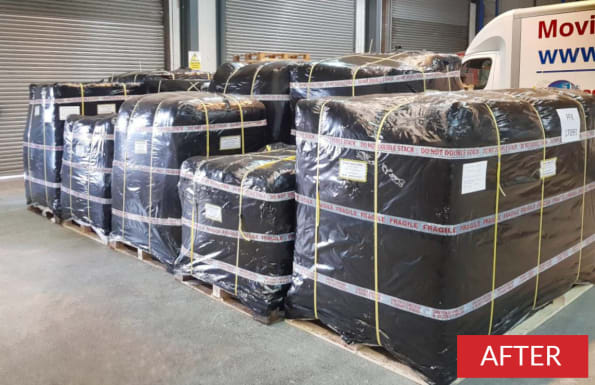
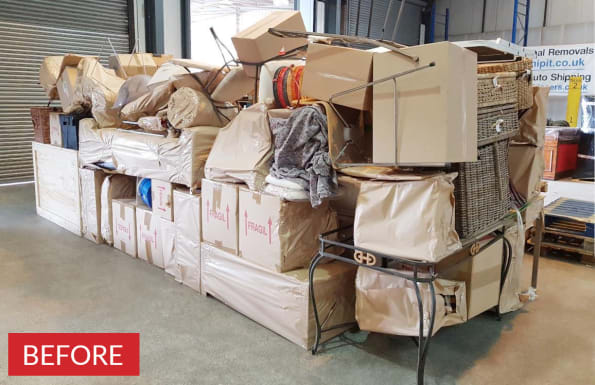
View on Facebook →Our unique shrink-fast packing method ensures full protection of your items.
Each Caribbean country sets its own customs rules for importing household goods and personal effects, and procedures vary noticeably across the region. In nearly all destinations, customs authorities will want to see proof that the goods are used personal belongings and not items being imported for resale.
The documents commonly required include:
Most Caribbean countries apply the CARICOM Common External Tariff, with duty rates typically ranging from 0 to 20 per cent and higher rates on certain categories such as vehicles, alcohol and luxury goods. Value Added Tax (or its local equivalent such as Antigua Barbuda Sales Tax, or General Consumption Tax in Jamaica), environmental levies and customs service charges are usually applied on top of duty. The Bahamas and the Dominican Republic operate outside the CARICOM tariff and have their own rates.
Your Move Manager will advise what is normally required for your specific destination and help you prepare the paperwork before your shipment leaves the UK.
Transit times from the UK to the Caribbean range from 9 to 35 days depending on the destination, with weekly sailings to all main ports. Direct services are available to Barbados, the Dominican Republic, Jamaica and Trinidad and Tobago. Other islands are typically served via a transhipment leg through Miami onto a smaller feeder vessel, which extends the transit time.
Typical port-to-port transit times to our Caribbean destinations:
You should allow additional time on top of port-to-port transit for collection, export packing, customs clearance and final delivery at the destination.
The cheapest way to ship personal effects and household goods to the Caribbean is by using our shared container service, also known as "groupage" or "less than container load" (LCL) shipping.
This service is ideal if you are shipping a smaller volume of items, for example just a few boxes or a small flat's worth of furniture, and don't need the entire space of a sole-use container.
Yes, we offer a full door-to-door service. Our nationwide UK collection covers all areas of the UK and we coordinate with trusted local agents at the destination for customs clearance and final delivery to your new home.
Yes, our free container tracking tool lets you track your shipment from the UK to the Caribbean. You’ll get your tracking number once your shipment has left the UK.
Yes, you can take your pet with you to the Caribbean from the UK. You must meet strict requirements to allow this.
Key requirements:
Yes, British citizens can live and work in the Caribbean, but each country has different visa requirements. You won't need a visa if you only plan on staying in most Caribbean countries for less than 90 days. You can apply for a Residence Permit for long-term stays and you'll need a Work Visa if you intend on living and working there.
For most visas in the Caribbean, you'll need to provide the following:
While not a requirement, it's advised to have valid health insurance as well.
Yes, many Caribbean countries offer a digital nomad visa, often referred to as a Welcome Stamp or Digital Residence. This lets you work remotely for up to 12 months without needing a Residence Visa. Some countries even allow you to stay there on the visa for up to 2 years whilst in others you can easily extend the period.
There are various visas offered in each Caribbean country, so you’d have to research your destination for a full breakdown. They are often as follows; Family, Investor, Residency, Digital Nomad, Student, Work, Business and Tourist.
The most popular visas are Residence and Work. To apply for a Work visa, you will need to be employed in the Caribbean or have a job offer in place and sponsorship from your employer.
The Caribbean offers a high quality of life for many. With well-developed healthcare, a warm climate and a low cost of living in rural regions, many UK movers have started a new life in the Caribbean.
Healthcare in the Caribbean differs by country, but most have public and private systems. Less developed areas see limited services and lower quality of healthcare, but in most parts, the service is of a high standard. It’s recommended to get health insurance before your move.
There are many international schools in the Caribbean, including in Jamaica, Trinidad and Tobago and Barbados. These schools offer the International Baccalaureate (IB), British National Curriculum, and American-based systems. International schools will come with higher fees than public schools, so factor this into your budget as there are no public international schools.
Primary education begins at 5 and ends at 11, while secondary school starts at 12 and finishes at 16 or 17. Notable universities include the University of the West Indies, the University of Trinidad and Tobago and the University of the Bahamas.
The cost of living in the Caribbean varies by country, but in general, it’s higher than in the UK. Food, goods and cars are imported, which makes the price tag higher than in the UK for lots of services. Property prices can also be high, especially in popular tourist destinations. It’s possible to find affordable housing in certain areas such as Belize and Dominica.
The job market varies significantly by country. In general, the tourist and hospitality sectors prove to be popular throughout all Caribbean countries and make up a significant part of the economy. The Cayman Islands, Bermuda, Bahamas, and Barbados are established offshore financial centres, with lots of opportunities in financial roles there.
Your life, carefully wrapped, beautifully packed, and protected for the journey ahead.
We are extremely proud of our unique packing process. We are the only moving company in the UK that uses this tried and tested method to ship your treasured personal possessions overseas.
Visit our Facebook page to find a snapshot of each shipment captured as the final pallet is wrapped.